
Why MSME Manufacturing Plants Struggle with Operations — And How Digital Transformation Can Help
Quick Answer
MSME manufacturing plants often struggle with operations because they rely on manual records, spreadsheets, delayed reporting, reactive maintenance, and limited shop-floor visibility. Digital transformation helps manufacturers track production, machines, inventory, quality, and workflow in real time. With tools like Production Monitoring Systems, MES, Industrial IoT, digital inventory, and automation, MSMEs can reduce downtime, improve productivity, control costs, and make faster business decisions.
Introduction to Digital Transformation in MSME Manufacturing
MSME manufacturers play a major role in India's industrial growth, employment generation, exports, and local supply chains. According to the Ministry of MSME's latest official figures, MSMEs contribute around 30.1% to India's GDP, 35.4% to manufacturing output, and 45.73% to exports. This makes MSME manufacturing one of the most important parts of the Indian economy.
However, many MSME manufacturing units still face daily operational challenges. Production delays, machine breakdowns, inventory mismatch, quality issues, and poor reporting often reduce profitability. In many factories, owners and managers do not get real-time visibility into what is happening on the shop floor.
This is where digital transformation can make a big difference. It helps MSMEs move from guesswork to data-driven manufacturing, where every important activity can be tracked, measured, and improved.
Why MSME Manufacturing Operations Face Daily Challenges
Many MSME manufacturing plants still depend on manual registers, Excel sheets, WhatsApp updates, paper-based reports, and verbal communication. These systems may work in the early stages of business, but they become difficult to manage as production grows.
The problem is not only lack of technology. It is also lack of real-time data. When information reaches the owner or plant manager late, decisions also become late. By the time a problem is identified, production loss, material wastage, or delivery delay may have already happened.
Common operational challenges include:
- No real-time production visibility
- Manual production reporting
- Unplanned machine breakdowns
- Poor inventory tracking
- Higher rejection and rework
- Delayed customer deliveries
- Weak coordination between departments
- Limited data for decision-making
These issues directly affect cost, productivity, customer satisfaction, and business growth.
Lack of Real-Time Production Visibility
Real-time visibility is one of the biggest problems in MSME manufacturing plants. Many owners only get production updates at the end of the shift or at the end of the day. This makes it difficult to identify bottlenecks while they are happening.
For example, if a machine is running below capacity, a worker is waiting for material, or a production line is stopped, management may not know immediately. This delay results in lower output and poor equipment utilization.
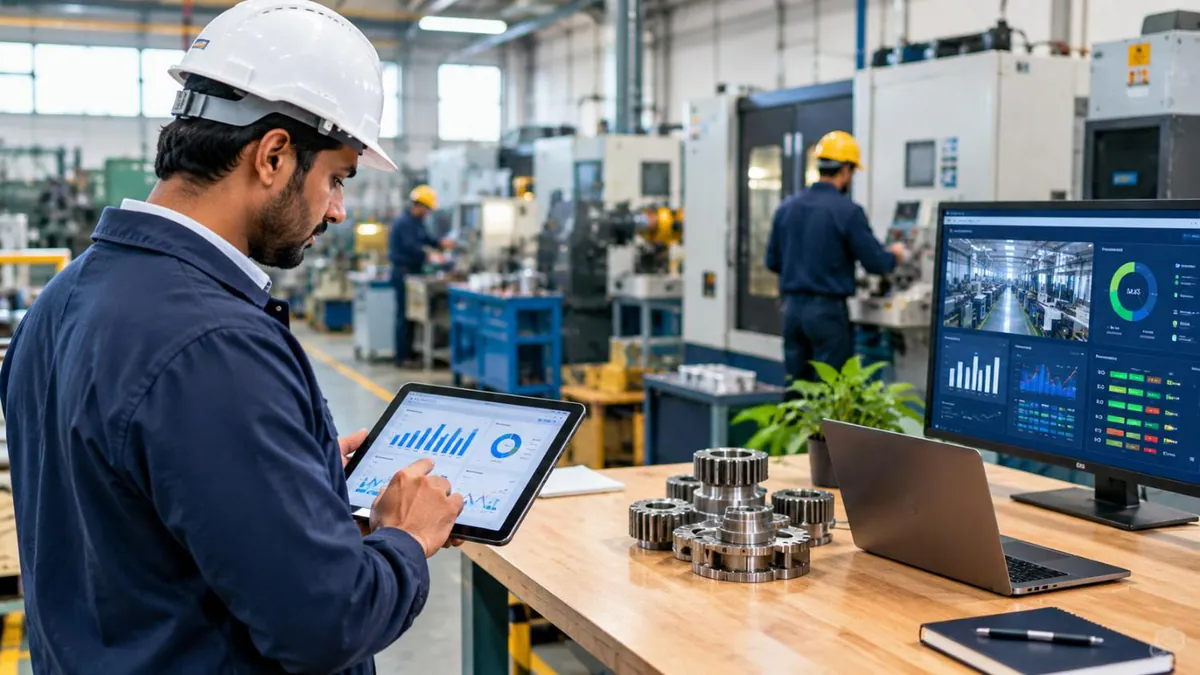
A digital production monitoring system can solve this by showing live production data, machine status, downtime, output, rejection, and shift-wise performance on a dashboard.
Machine Downtime and Maintenance Issues
Unplanned machine breakdowns are a major reason for production loss in MSME manufacturing plants. Many businesses follow reactive maintenance, which means they repair machines only after a breakdown happens.
This approach increases downtime, repair costs, delivery delays, and production pressure. In some cases, one machine breakdown can disturb the entire production schedule.
Digital maintenance tracking helps manufacturers record machine history, breakdown reasons, spare part usage, maintenance schedules, and downtime patterns. Over time, this helps MSMEs move from reactive maintenance to planned maintenance.
Inventory and Working Capital Problems
Inventory management is another major challenge for MSME manufacturers. Excess stock blocks working capital, while stock shortages stop production and delay orders.
Manual inventory tracking often leads to inaccurate stock records. Raw materials may be available in the system but missing on the shop floor. Finished goods may be ready but not updated properly. These gaps create confusion between production, purchase, stores, and sales teams.
Digital inventory management helps MSMEs track raw materials, work-in-progress, finished goods, reorder levels, and material movement more accurately. This supports better production planning and improves working capital control.
Quality Control and Rejection Challenges
Quality issues can become expensive for manufacturing MSMEs. Manual quality checks, incomplete inspection records, and poor traceability can increase rejection, rework, warranty claims, and customer complaints.
When quality data is not recorded properly, it becomes difficult to understand the real reason behind defects. The issue may be related to raw material, machine settings, operator handling, process gaps, or supplier quality.
Digital quality control systems help record inspection results, defect types, rejection trends, batch history, and corrective actions. This helps manufacturers improve quality and reduce repeated mistakes.
How Digital Transformation Solves These Problems
Digital transformation means using technology to improve business processes, production systems, data collection, and decision-making. For MSME manufacturers, it does not mean replacing everything at once. It means digitizing the most important areas step by step.
A digitally enabled manufacturing plant can collect real-time data from machines, operators, inventory systems, quality checks, and production lines. This data helps owners and managers understand what is working, what is delayed, and where improvement is needed.
Digital transformation can help MSMEs:
- Track production in real time
- Reduce machine downtime
- Improve inventory accuracy
- Control rejection and rework
- Improve delivery planning
- Reduce manual errors
- Increase equipment utilization
- Improve coordination between teams
- Make faster and better decisions
The result is a more productive, transparent, and cost-efficient manufacturing operation.
Key Digital Tools for MSME Manufacturers
MSMEs do not need to adopt every tool at once. The right tool depends on the business size, production process, budget, and current pain points.
Production Monitoring System
A production monitoring system tracks production output, machine performance, downtime, shift-wise targets, and actual performance. It helps plant managers identify production gaps quickly.
Manufacturing Execution System
A Manufacturing Execution System, or MES, connects production planning with shop-floor execution. It helps manage work orders, production status, quality checks, material usage, and operator activity.
Industrial IoT
Industrial IoT uses sensors, connected devices, and machine data to monitor equipment performance, energy usage, production speed, temperature, vibration, and other process parameters.
Digital Inventory Management
Digital inventory systems help track stock levels, raw material movement, finished goods, reorder points, and consumption patterns. This reduces overstocking and stockouts.
Digital Quality Control
Digital quality systems help record inspection results, defect reasons, rejection data, and corrective actions. This improves traceability and quality decision-making.
Workflow Automation
Workflow automation reduces delays in approvals, reporting, purchase requests, maintenance tickets, and production updates. It improves coordination between teams.
Dashboards and MIS Reports
Dashboards give owners and managers a clear view of production, inventory, downtime, quality, and delivery performance. This helps in faster decision-making.
Government Support for MSME Operational Improvement
Digital transformation also connects well with India's broader push towards better manufacturing competitiveness. Initiatives such as SAMARTH Udyog Bharat 4.0 aim to spread Industry 4.0 awareness among Indian manufacturing industries.
MSMEs can also explore schemes and initiatives related to lean manufacturing, quality improvement, technology upgradation, and ZED Certification. The MSME Competitive (Lean) Scheme focuses on improving productivity, reducing waste, improving quality, lowering cost, and reducing production lead time. ZED Certification encourages MSMEs to follow Zero Defect Zero Effect practices.
For many MSMEs, the right combination of operational improvement, digital tools, funding support, and government scheme guidance can make transformation more practical. GRO-MSME's machinery and equipment loan support and guidance on MSME subsidies and government schemes can help you identify the right scheme and funding route for your plant.
Benefits of Digital Transformation for MSME Manufacturing Plants
Digital transformation gives MSME manufacturers better control over daily operations. It reduces dependency on guesswork and helps management take decisions based on actual data.
Key benefits include:
- Better production visibility
- Lower machine downtime
- Improved productivity
- Reduced rejection and rework
- Better inventory control
- Improved working capital management
- Faster decision-making
- Better on-time delivery
- Lower operational cost
- Improved customer satisfaction
In competitive markets, these benefits can directly improve profitability and long-term business strength.
Challenges MSMEs Should Plan For
Digital transformation is useful, but MSMEs should plan it carefully. Many businesses fail because they buy software without understanding their process gaps.
Common challenges include:
- Lack of clear digital roadmap
- Resistance from employees
- Poor data discipline
- Limited budget
- Weak internet or IT infrastructure
- Choosing the wrong software
- Lack of training
- No integration between systems
The solution is to start small, solve one major problem first, train the team properly, and then expand digital adoption step by step.
How MSMEs Can Start Their Digital Transformation Journey
MSME manufacturers do not need to digitize the entire plant on day one. A phased approach is more practical and cost-effective.
A good starting process can include:
- Identify the biggest operational pain point
- Map the current production and reporting process
- Track where time, money, and material are being wasted
- Start with one digital tool, such as production monitoring or inventory tracking
- Train the team before implementation
- Review data weekly
- Improve SOPs based on digital insights
- Expand gradually to quality, maintenance, and workflow automation
This approach helps MSMEs reduce risk and build digital maturity over time.
Why Digital Transformation Is No Longer Optional
Manufacturing is becoming more competitive, cost-sensitive, and quality-driven. Customers expect faster delivery, better quality, lower defects, and more transparency. Large buyers also prefer suppliers who can provide reliable production, traceability, and consistent quality.
MSMEs that continue using only manual systems may struggle to scale. On the other hand, manufacturers that adopt digital tools early can improve efficiency, reduce waste, and become more reliable suppliers.
Digital transformation is no longer limited to large companies. Affordable, modular, and scalable solutions are now available for MSMEs as well.
Final Takeaway
MSME manufacturing plants struggle with operations mainly because they lack real-time visibility, structured processes, accurate data, and timely decision-making. These issues lead to downtime, inventory problems, quality failures, delayed deliveries, and lower profitability.
Digital transformation helps MSMEs solve these problems by making operations more visible, measurable, and controlled. Tools like production monitoring, MES, Industrial IoT, digital inventory, quality tracking, and automation can help manufacturers improve productivity and reduce costs.
The future of manufacturing belongs to smart, connected, and data-driven businesses. MSMEs that start their digital journey today will be better prepared to grow, compete, and serve customers with greater confidence. If you'd like guidance on where to begin, contact the GRO-MSME team or explore becoming a GRO-MSME consultant to help other manufacturers on this journey.
Frequently Asked Questions About Digital Transformation in MSME Manufacturing
Why do MSME manufacturing plants struggle with operations?
MSME manufacturing plants often struggle because they depend on manual records, delayed reporting, poor inventory tracking, reactive maintenance, and limited visibility into shop-floor performance.
What is digital transformation in MSME manufacturing?
Digital transformation in MSME manufacturing means using digital tools to improve production tracking, machine monitoring, inventory control, quality management, workflow, and decision-making.
How can digital transformation reduce machine downtime?
Digital tools can track machine performance, downtime reasons, maintenance history, and breakdown patterns. This helps MSMEs plan maintenance before major breakdowns happen.
Which digital tool should MSME manufacturers start with?
Most MSMEs can start with production monitoring, inventory management, or digital quality control. The best starting point depends on where the business is losing the most time, money, or productivity.
Is digital transformation affordable for MSMEs?
Yes, many digital solutions are now available in modular and scalable formats. MSMEs can start with one department or one process instead of digitizing the full plant at once.
How does digital transformation improve inventory management?
Digital inventory tools help track raw materials, work-in-progress, finished goods, reorder levels, and material movement. This reduces excess stock, shortages, and working capital blockage.
Can digital transformation improve product quality?
Yes. Digital quality systems help record inspection data, defect reasons, rejection trends, and corrective actions. This helps MSMEs reduce repeated mistakes and improve product consistency.
How can digital transformation improve working capital?
Better production and inventory visibility helps MSMEs reduce excess inventory, avoid emergency purchases, improve planning, and control wastage. This can free up working capital.
What are the challenges of digital transformation for MSMEs?
Common challenges include limited budget, employee resistance, lack of training, poor data discipline, weak IT infrastructure, and choosing the wrong digital tools.
How can GRO-MSME help manufacturing businesses?
GRO-MSME helps manufacturing businesses with business growth advisory, funding support, government scheme guidance, technology upgradation support, operational improvement, and MSME development solutions.